Human behavior distillation
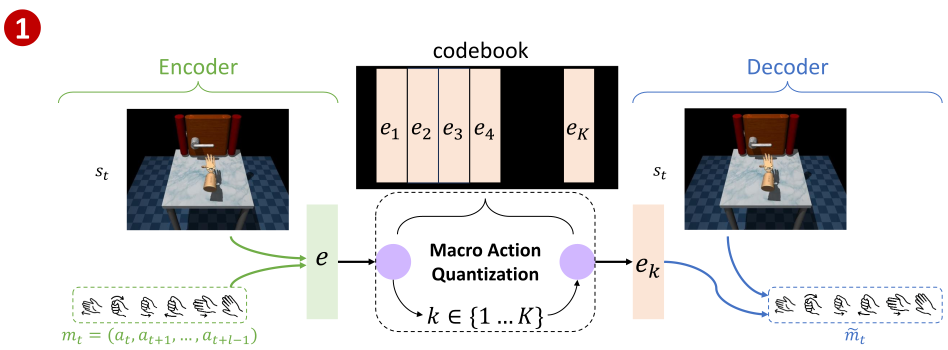
A Conditional VQ-VAE learns macro actions from sliding windows over human action trajectories.
NeurIPS 2025 Main Track
MAQ learns discrete, reusable macro actions from human demonstrations and combines them with reinforcement learning to produce more human-like control behavior.
Abstract
Reward-optimized reinforcement learning agents can perform well while following trajectories that differ markedly from human demonstrations. MAQ frames human-likeness as a trajectory optimization problem and learns a discrete macro-action codebook from demonstration windows with a Conditional VQ-VAE.
An RL policy then selects codebook indices instead of individual actions. This formulation can be integrated with offline and online RL algorithms, improving trajectory similarity on D4RL Adroit tasks and human-likeness in a two-stage human evaluation.
Method
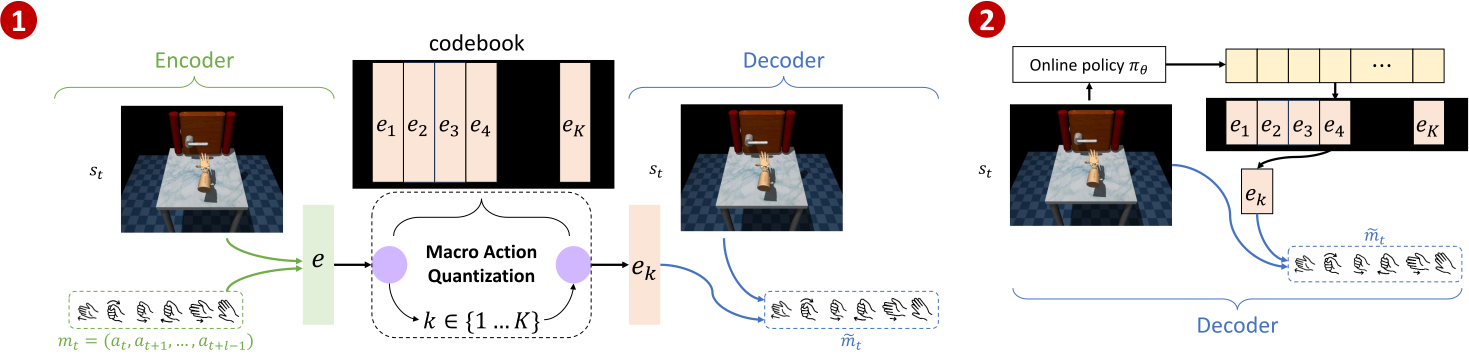
MAQ separates the representation of human behavior from policy learning. First, it learns a discrete codebook of reusable action sequences from human demonstrations. Then an RL agent operates in this compact code space and decodes each selected code into an executable macro action.
A Conditional VQ-VAE learns macro actions from sliding windows over human action trajectories.
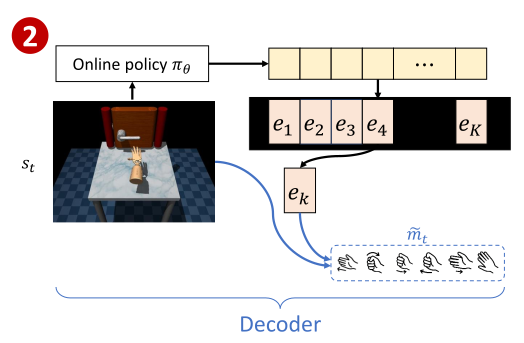
The policy acts in the learned discrete code space, then the decoder converts each selected code into a macro action.
Results
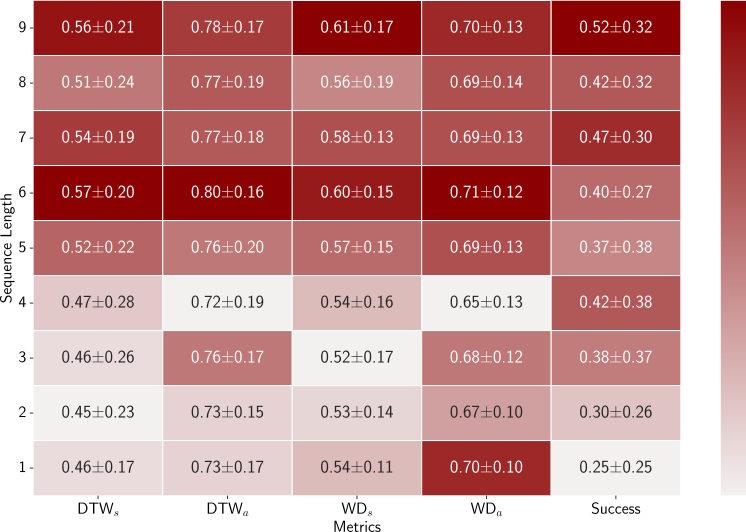
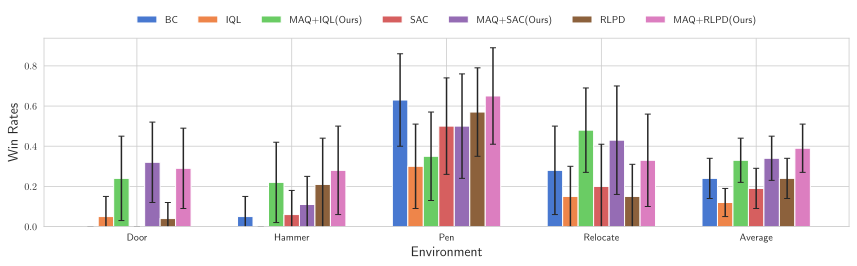
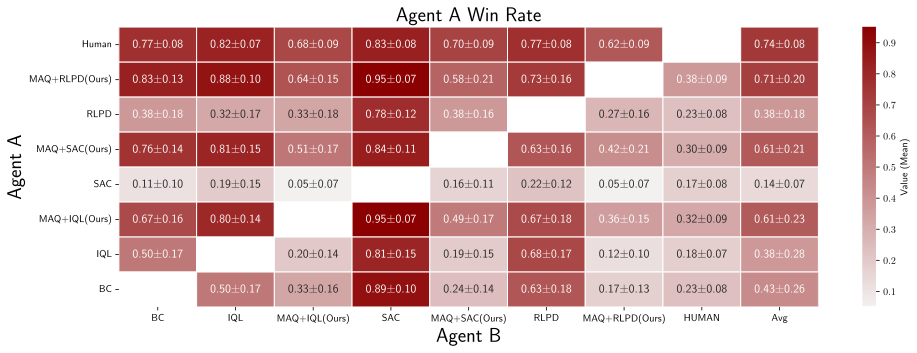
Experiments on D4RL Adroit benchmarks show that MAQ improves trajectory similarity when integrated with IQL, SAC, and RLPD. The evaluation uses Dynamic Time Warping and Wasserstein Distance to compare agent behavior with human demonstrations.
| Pair | DTWs | WDs | Success |
|---|---|---|---|
| IQL to MAQ+IQL | 0.21 to 0.63 | 0.38 to 0.64 | 0.14 to 0.39 |
| SAC to MAQ+SAC | -0.49 to 0.56 | -0.17 to 0.59 | 0.19 to 0.28 |
| RLPD to MAQ+RLPD | 0.10 to 0.56 | 0.08 to 0.61 | 0.68 to 0.52 |
Qualitative Results
Select an RL algorithm to compare its baseline behavior with the MAQ-enhanced variant across four Adroit manipulation tasks.
Door · MAQ+RLPD
Door · RLPD
Hammer · MAQ+RLPD
Hammer · RLPD
Pen · MAQ+RLPD
Pen · RLPD
Relocate · MAQ+RLPD
Relocate · RLPD
Door · MAQ+SAC
Door · SAC
Hammer · MAQ+SAC
Hammer · SAC
Pen · MAQ+SAC
Pen · SAC
Relocate · MAQ+SAC
Relocate · SAC
Door · MAQ+IQL
Door · IQL
Hammer · MAQ+IQL
Hammer · IQL
Pen · MAQ+IQL
Pen · IQL
Relocate · MAQ+IQL
Relocate · IQL
Citation
@inproceedings{
guo2025learning,
title={Learning Human-Like {RL} Agents Through Trajectory Optimization With Action Quantization},
author={Jian-Ting Guo and Yu-Cheng Chen and Ping-Chun Hsieh and Kuo-Hao Ho and Po-Wei Huang and Ti-Rong Wu and I-Chen Wu},
booktitle={Advances in Neural Information Processing Systems},
year={2025},
url={https://openreview.net/forum?id=1A4Nlibwl5}
}